


Through-Hole vs. SMT Assembly: Which Is Right for Your PCB?
Two assembly technologies dominate PCB production: surface mount technology (SMT) and through-hole assembly (TH). Most electronics engineers are familiar with both, but the choice of which to use, and in what combination, has real consequences for board performance, cost, and manufacturability.
This article covers how each method works, where each excels, and how to think about them when designing a custom PCB for contract assembly.
How Through-Hole Assembly Works
In through-hole assembly, component leads are inserted through drilled holes in the board and soldered on the opposite side. The mechanical connection between the lead and the board barrel provides strong physical retention, which is one reason through-hole components remain the preferred choice for connectors, edge terminals, large capacitors, and power components that will experience stress.
Wave soldering is the most common method for through-hole production: boards pass over a wave of molten solder, which wets the exposed leads. Selective soldering is used when only specific areas of the board need to be soldered and the rest would be damaged by full-board wave exposure.
How SMT Assembly Works
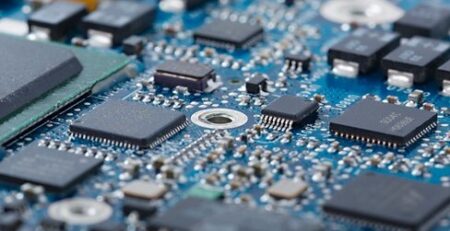
In surface mount technology, components are mounted directly onto pads on the board surface and attached by reflowing solder paste. Components are much smaller than through-hole equivalents, which allows for higher circuit density and double-sided assembly.
The SMT process is highly automated. For a step-by-step breakdown, see our article on the SMT assembly process.
Key Differences
Board Space and Component Density
SMT wins on density. Surface mount components are available in extremely small packages, and boards can be populated on both sides. Through-hole components require drilled holes that consume board real estate and limit routing options on inner layers.
Mechanical Strength
Through-hole connections are stronger under physical stress. If your product will experience vibration, shock, or repeated mating cycles at a connector, through-hole provides more mechanical reliability for those specific components.
Thermal Performance
Through-hole components can sometimes handle higher power dissipation because their leads act as heat paths to the board. For high-power applications, through-hole remains relevant even on otherwise SMT-dominated boards.
Cost and Production Speed
SMT assembly is faster and more cost-effective at volume because the process is fully automated. Through-hole insertion adds manual labor or requires selective soldering equipment, both of which add cost. At high volumes, minimizing through-hole components is generally a cost-reduction lever.
Component Availability
Most modern ICs and passive components are only available in surface mount packages. The catalog of through-hole components has shrunk considerably over the past decade. If your design relies heavily on through-hole devices, you may face sourcing constraints or higher component costs.
Mixed Technology Boards
Most production boards use both technologies. A typical custom PCB might use SMT for all ICs and passive components while using through-hole for board-to-board connectors, USB ports, power input headers, and large electrolytic capacitors. This mixed approach takes advantage of the density and automation benefits of SMT while using through-hole where mechanical or thermal requirements demand it.
Mixed technology boards require careful planning during DFM review. The sequence of operations matters: SMT reflow typically happens first, followed by through-hole insertion and wave or selective soldering. Thermal exposure during wave soldering can stress SMT components on the bottom side of the board if the process is not controlled properly.
Making the Right Call for Your Design
A few questions to guide the decision:
- Does the component only come in a surface mount package? Use SMT.
- Is the component a high-stress connector or large power device? Consider through-hole.
- Is board space a constraint? Favor SMT.
- Is the product exposed to shock or vibration in service? Through-hole connections at critical points add robustness.
- Are you building at volume and need to minimize cost? Reduce through-hole content where possible.
Design choices around assembly technology connect directly to manufacturability. Our article on design for manufacturability for PCB assembly covers how these decisions affect production cost and quality. For a full picture of what SVTronics can assemble, visit our Custom PCB Manufacturing and Assembly page.




Leave a Reply