


ATE Assembly for the Semiconductor Industry
Automated Test Equipment (ATE) is a sophisticated system designed to validate the functionality and performance of integrated circuits (ICs) with precision and speed. ATE safely powers up the IC under test, applies predefined electrical patterns and signals, and measures the device’s responses across digital, analog, and RF domains. These measurements are analyzed in real-time to determine whether the IC meets its design specifications, delivering a pass/fail result in mere milliseconds. ATE systems also log critical yield and quality data, providing valuable insights for process optimization and defect analysis. This combination of speed, accuracy, and data-driven feedback makes ATE an indispensable tool for ensuring the reliability of semiconductor devices in high-volume production environments.
What is Automated Test Equipment (ATE)?
Automated Test Equipment (ATE) refers to the complex hardware and software systems engineered to validate the functionality, performance, and integrity of ICs with exceptional precision and speed. ATE system functions as a highly sophisticated measurement and stimulus instrument. They:
- Safely power up the IC under test (DUT)
- Apply a series of predefined electrical patterns and signals to its inputs
- Meticulously measure the resulting digital, analog, and RF responses at its outputs
These measurements are captured and analyzed in real-time against the device’s design specifications. The system then delivers a pass/fail determination, often in milliseconds, enabling the rapid sorting of devices. Beyond this primary sorting function, ATE systems are instrumental in data collection. They log critical yield and quality data for every device tested, creating a rich dataset that provides invaluable insights for process optimization, root cause analysis of failures, and defect analysis. This powerful combination of speed, accuracy, and data-driven feedback makes ATE an indispensable tool for ensuring the reliability and quality of semiconductor devices in high-volume production environments, where millions of units must be tested daily.
Hardware Required for Each IC Test Program
Every IC test program depends on a suite of specialized hardware to establish a seamless and high-fidelity connection between the ATE system and the DUT. This physical interface is not a generic set of components; it is custom-engineered to meet the specific electrical and mechanical requirements of the device and the tester. SVTronics manufactures this critical physical interface, which includes load boards, DUT boards, socket boards, handler interface kits, and other custom test hardware.
The design and fabrication of these components are paramount for successful testing. They must ensure precise signal integrity for high-speed data, maintain power integrity for high-current devices, and provide a mechanically stable platform for repeatable measurements. The quality of this hardware directly impacts test yield, accuracy, and throughput. By providing manufactured interface solutions, we enable accurate and repeatable testing for even the most complex and demanding semiconductor devices on the market.
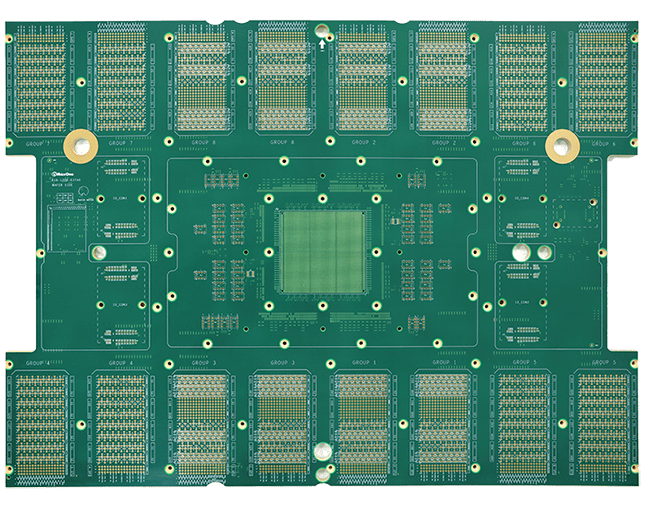
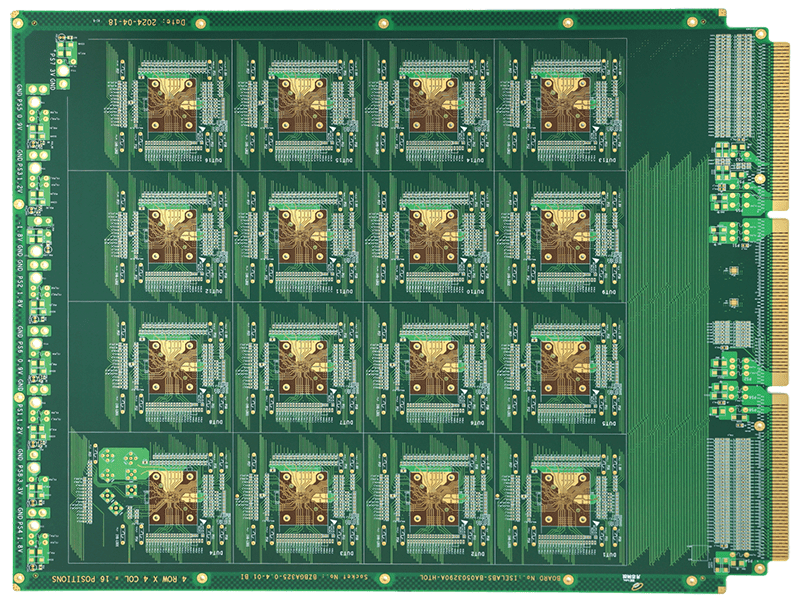
Load boards, also known as interface boards or DIBs (Device Interface Boards), are highly specialized printed circuit boards (PCBs) that represent the foundational element of the IC test hardware stack. These are not standard PCBs; they are complex, custom-engineered, high-layer-count assemblies, often ranging from 20 to over 50 layers. Their primary function is to accurately route the hundreds or thousands of channels from the ATE tester’s pogo pin interface to the specific pin locations of the DUT.
To manage the intricate requirements of modern IC testing, load boards integrate a variety of active and passive components. These can include relays for signal path switching, protection circuits to prevent electrical overstress (EOS), filtering elements to condition signals, and level-shifting components to adapt tester voltage levels to those of the DUT. Controlled impedance routing is a non-negotiable design requirement, ensuring that high-speed signals propagate without distortion or degradation.
These boards must handle significant power loads. High current capability is achieved through the use of heavy copper planes and meticulously planned power delivery networks (PDNs). This robust construction, combined with advanced thermal design principles, enables effective heat dissipation and stable power delivery
At SVTronics, we place the highest priority on signal integrity (SI) and power integrity (PI) in every load board we manufacture. This engineering focus ensures optimal, reliable performance for the most demanding semiconductor test applications, from mobile processors to high-performance computing (HPC) and automotive ICs.
Load boards, also known as interface boards or DIBs (Device Interface Boards), are highly specialized printed circuit boards (PCBs) that represent the foundational element of the IC test hardware stack. These are not standard PCBs; they are complex, custom-engineered, high-layer-count assemblies, often ranging from 20 to over 50 layers. Their primary function is to accurately route the hundreds or thousands of channels from the ATE tester’s pogo pin interface to the specific pin locations of the DUT.
To manage the intricate requirements of modern IC testing, load boards integrate a variety of active and passive components. These can include relays for signal path switching, protection circuits to prevent electrical overstress (EOS), filtering elements to condition signals, and level-shifting components to adapt tester voltage levels to those of the DUT. Controlled impedance routing is a non-negotiable design requirement, ensuring that high-speed signals propagate without distortion or degradation.
These boards must handle significant power loads. High current capability is achieved through the use of heavy copper planes and meticulously planned power delivery networks (PDNs). This robust construction, combined with advanced thermal design principles, enables effective heat dissipation and stable power delivery.
At SVTronics, we place the highest priority on signal integrity (SI) and power integrity (PI) in every load board we manufacture. This engineering focus ensures optimal, reliable performance for the most demanding semiconductor test applications, from mobile processors to high-performance computing (HPC) and automotive ICs.
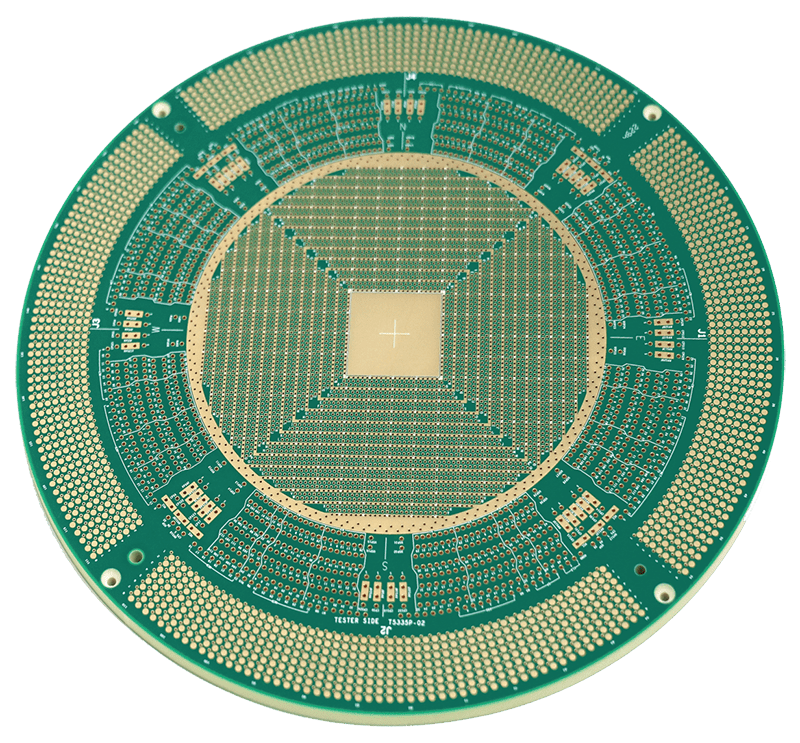
Socket boards provide the critical mechanical and electrical interface that holds the test socket or contactor assembly. The test socket is responsible for making temporary, reliable electrical contact with the pads, balls, or leads of the DUT. The socket board ensures this connection is precise, repeatable, and robust. These boards are engineered to support the latest packaging technologies, including fine-pitch devices and high-density ball grid arrays (BGAs), where alignment tolerances are measured in microns.
A key performance metric for socket boards and their associated sockets is high insertion cycle durability. In a production environment, a socket may be actuated hundreds of thousands or even millions of times. The socket board must withstand these mechanical stresses without degradation to its electrical performance or planarity. At SVTronics, we manufacture socket boards that deliver exceptional mechanical stability and electrical reliability, ensuring accurate connections throughout the rigorous demands of high-volume manufacturing test cycles.
The Handler Interface Kit (HIK) consists of the mechanical mounting hardware and stiffeners required to ensure precise and rigid alignment between the automated handler and the tester head. In high-volume production, ICs are moved into and out of the test socket by an automated handler system. The HIK guarantees that the test hardware stack (load board, DUT board, socket board) is perfectly positioned relative to the handler’s pick-and-place mechanism.
This alignment is absolutely critical for maintaining high yield and repeatability. Any minute misalignment can lead to improper device seating in the socket, causing contact issues, false failures, and potentially damaging the DUT or the test socket. By securely mounting and positioning the entire test hardware assembly, the HIK minimizes mechanical variability and guarantees consistent, reliable contact between every device and the test system. This mechanical precision is foundational to an efficient, high-yield, and cost-effective testing process.
Advanced ATE Board Capabilities
To meet the ever-increasing complexity and performance demands of modern semiconductor devices, ATE hardware must be fabricated using the most advanced manufacturing processes available. SVTronics delivers cutting-edge ATE board manufacturing capabilities that enable our clients to test the next generation of ICs. Our advanced technical capabilities include:
- 50+ Layer PCB Capability: We fabricate highly complex PCBs with more than 50 layers, enabling the dense routing required for high-pin-count devices.
- 16:1+ Aspect Ratio: Our processes support high aspect ratio vias (the ratio of PCB thickness to drill diameter), allowing for reliable connections through very thick and complex board stackups.
- .002” Drill Tolerances: We maintain exceptionally tight drill tolerances to ensure precise layer-to-layer registration and connectivity for fine-pitch components.
- 64Gbps SerDes Support: We manufacture controlled-impedance boards engineered to maintain signal integrity for high-speed SerDes interfaces like PCIe Gen6 and PAM4, supporting data rates of 64 Gbps and beyond.
- 1000A Ultra-High Current Capability: Our expertise in heavy copper and advanced thermal management enables the design of boards that can handle ultra-high current applications up to 1000A for power ICs and voltage regulators.
- Fine Pitch Down to 90µm: We support the assembly of fine-pitch components with spacing as narrow as 90µm, accommodating the densest IC layouts and package types.
- Multi-Site DUT Configurations: We enable parallel testing of multiple devices simultaneously by designing and fabricating multi-site load boards, dramatically increasing test throughput.
- 12,000+ Pin Support: Our design and manufacturing capabilities can accommodate devices with over 12,000 pins, addressing the needs of large SoCs, FPGAs, and processors.
- Controlled Impedance Stackups: We work with clients to design and verify precise impedance-controlled layer stackups, which are essential for high-speed signal performance.
- Hard Gold / Flash Gold Finishes: We offer various surface finishes, including hard gold for high-wear contact surfaces and flash gold for excellent solderability and wire bonding, ensuring durability and reliability.
Supporting the Full IC Test Lifecycle
Effective ATE hardware development is not a one-time manufacturing task; it is an ongoing process that spans the entire IC product lifecycle. SVTronics provides comprehensive, end-to-end support to ensure a seamless and efficient transition from initial design to high-volume production. Our expertise includes:
- Characterization Builds: We assemble the hardware required for device characterization, where performance is evaluated across a wide range of operating conditions, voltages, and temperatures.
- Production Scaling with Repeatability: We have the capacity and processes in place to scale from initial prototype builds to high-volume production, ensuring that every board manufactured meets the same high standards of quality and repeatability.
- Change Control and Traceability: We maintain rigorous change control and traceability systems, documenting all materials and processes to ensure quality, compliance, and rapid root cause analysis if issues arise.
- SVT offers in-house capabilities to support hardware modifications and ECN’s.
Partnering with SVTronics means you can confidently navigate every stage of the IC test lifecycle, backed by our commitment to precision, reliability, and engineering excellence.
Why Choose SVTronics for ATE Hardware?
Choosing the right partner for ATE hardware assembly is a critical decision that directly impacts product quality, time-to-market, and program success. SVTronics stands out as a trusted, industry-leading partner, offering unmatched expertise, quality, and reliability. Our high-reliability manufacturing standards, honed over years of supporting mission-critical industries, ensure unparalleled precision and consistency in every project.
As an ITAR-registered and CMMC Level II-compliant manufacturer, we possess the security controls and process discipline required to handle sensitive aerospace, defense, and other high-security semiconductor programs with complete confidence. This compliance is a testament to our commitment to quality and security.
We bring extensive experience in engineering collaboration during the New Product Introduction (NPI) phase, working as an extension of your team to optimize designs for manufacturability (DFM) and performance. From initial prototypes to full-scale production, SVTronics provides seamless scalability to meet your evolving needs. When you choose SVTronics, you are choosing a dedicated partner committed to the long-term success of your semiconductor testing programs.
FAQs
An ATE load board is a specialized printed circuit board that serves as the interface between Automated Test Equipment and a semiconductor device. It routes tester signals to the device pins while incorporating features like signal conditioning, power management, and protection circuits.
SVTronics is capable of producing high-layer-count PCBs, including designs with over 50 layers, ensuring precision with tight drill tolerances and controlled impedance configurations.
Absolutely. SVTronics manufactures advanced boards with controlled impedance, designed to handle high-speed protocols such as PCIe and PAM4, supporting data rates of 64Gbps and higher.
Yes, we specialize in heavy copper PCB designs that support ultra-high current applications up to 1000A, with a focus on maintaining thermal and power integrity.
Yes, SVTronics is ITAR registered and CMMC Level II compliant, making us a trusted partner for aerospace, defense, and other secure semiconductor applications.
Let’s build something incredible
Upload the details to have our system price your next project